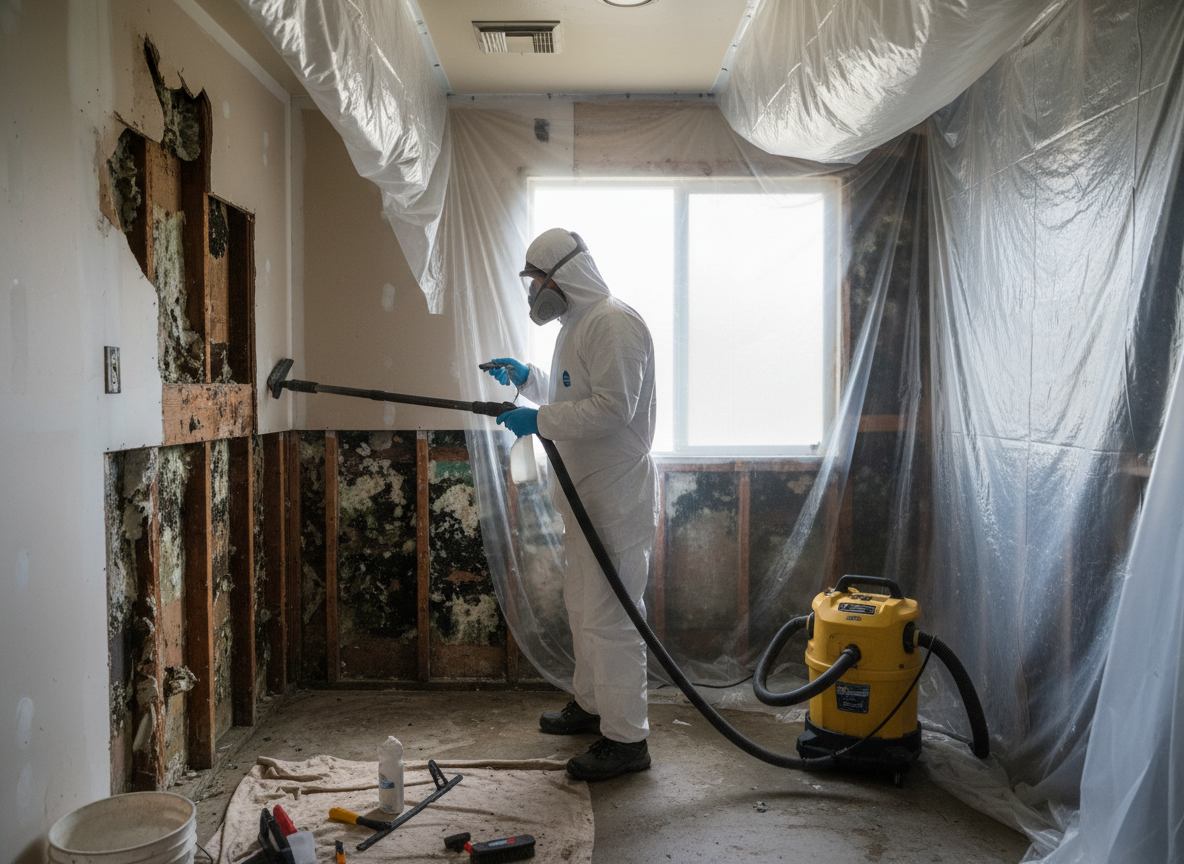
Canoga Park homes built in the 1960s and 1970s around Warner Center often have single-story ranch construction with flat or low-slope roofs and limited attic ventilation. When hot dry summers drive constant air conditioning use, condensation forms behind drywall and in insulation near Pierce College and along Saticoy Street. Mold abatement here requires cutting precise access points rather than whole-room demolition to preserve original plaster and avoid disturbing knob-and-tube wiring still present in many blocks.
Los Angeles County building codes require negative-air machines and HEPA filtration during removal whenever visible growth exceeds ten square feet. In neighborhoods bordering Chatsworth and Winnetka, stucco exteriors trap rainwater against wood framing after rare winter storms, so abatement crews must check exterior wall cavities even when interior signs appear limited. We use moisture meters calibrated for the local adobe-rich soil that holds water longer than sandy coastal soils.
After physical removal, rapid drying with commercial dehumidifiers prevents regrowth in the low-humidity air that returns once summer resumes. Homeowners near Westfield Topanga frequently discover mold in HVAC ducts because the same dry heat that feels comfortable outside forces systems to cycle more often, spreading spores through shared walls common in townhome developments.
Technician insight
In Canoga Park, the thing that catches most people out with mold abatement is how the constant summer AC use in 1960s ranch homes around Warner Center pushes condensation into wall cavities that never see direct rain, so the first sign is often a musty smell near electrical outlets rather than visible water stains.
Attic Mold After AC Condensation
A Canoga Park homeowner near Pierce College reported a persistent odor in the hallway. Inspection revealed mold on roof sheathing caused by attic condensation from an oversized AC unit running nonstop during summer. We isolated the attic, removed affected insulation, dried the space, and verified clearance before reinstalling new insulation.
How it works
- 1
On-site Assessment
Technicians inspect attics, walls, and HVAC systems using moisture meters and borescopes to map all affected materials without disturbing the structure.
- 2
Containment Setup
Plastic barriers and negative-air machines isolate the work zone so spores do not migrate into living spaces or neighboring units in Canoga Park townhomes.
- 3
Material Removal
Porous materials like insulation and drywall are cut out and bagged for disposal; non-porous surfaces are HEPA-vacuumed and wiped with antimicrobial solutions.
- 4
Drying and Clearance
Industrial dehumidifiers and air movers dry remaining cavities, followed by post-remediation testing to confirm moisture and spore levels meet clearance criteria.
Pricing
Pricing varies by square footage affected, depth of hidden growth, and access difficulty; we provide detailed upfront quotes after the initial inspection.