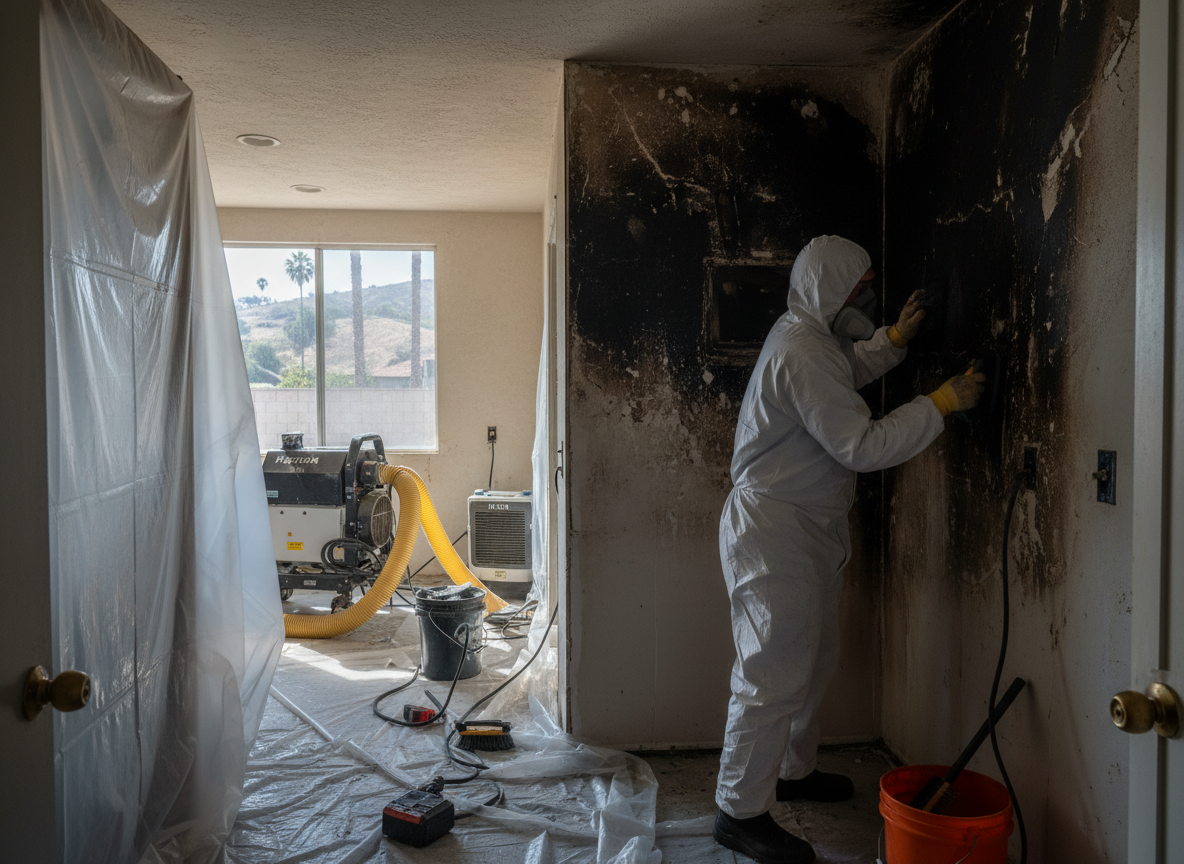
Canoga Park homes built in the 1950s and 1960s often feature slab foundations and older plumbing runs that crack under seasonal ground movement. When summer temperatures climb and residents increase air conditioning use, condensation forms behind walls and under cabinets where airflow is poor. A small roof leak near the eave or a slow drip from a bathroom supply line can feed black mold colonies for months before visible spots appear on drywall. Technicians working these properties must pull baseboards and test moisture levels in the subfloor because the dry climate masks ongoing humidity pockets that standard visual checks miss.
Properties close to Warner Center and along Saticoy Street sit on flat terrain that drains slowly after rare winter rains. Water pools against stucco foundations and wicks upward into wood framing. In these cases containment must extend beyond the obvious stain because spores travel through HVAC returns that serve multiple rooms. Removal includes cutting away affected drywall at least eighteen inches past visible growth and HEPA vacuuming every surface before any reconstruction. Homeowners who attempt bleach cleaning on their own often drive spores deeper into porous materials like the particleboard cabinets common in 1960s tract homes.
Los Angeles County building codes require proper disposal of contaminated materials and negative air pressure during work. Skipping these steps risks cross-contamination into adjacent units in the attached garages and carports typical of Canoga Park neighborhoods. After removal, drying equipment must run long enough to drop moisture content below fifteen percent in framing lumber, a threshold that takes longer here than in coastal zones because the hot dry air outside can create false readings on surface meters. Final clearance testing confirms the space is safe before any new finishes are installed.
Technician insight
In Canoga Park the thing that catches most people out with mold remediation company is the combination of 1960s slab homes near Pierce College and the hot dry summers that hide moisture under cabinets until it reaches the subfloor. Homeowners often paint over spots thinking the dry climate will stop it, but the AC condensate keeps feeding the colony behind the wall.
Hidden Growth After Bathroom Leak
A homeowner near Westfield Topanga noticed a musty smell in the hallway but no visible spots. Inspection found a slow leak from a 1970s supply line that had soaked the particleboard vanity base and traveled under the slab edge. Containment was set around the bathroom, affected cabinetry and drywall were removed, and drying equipment ran for four days until readings stabilized. Clearance testing passed and the family moved back in without further odor.
How it works
- 1
Initial Assessment
Technician inspects all affected rooms, measures moisture in walls and floors, and maps hidden growth using infrared and moisture meters.
- 2
Containment Setup
Plastic barriers and negative air machines isolate the work zone to prevent spores from moving through HVAC systems or into neighboring rooms.
- 3
Removal and Cleaning
Damaged drywall, insulation, and baseboards are cut out and bagged; remaining surfaces receive HEPA vacuuming and antimicrobial treatment.
- 4
Drying and Verification
Industrial dehumidifiers and air movers run until moisture readings drop to safe levels, followed by post-remediation air sampling.
- 5
Prevention Recommendations
Report includes specific fixes for the moisture source such as improved grading near the foundation or vent adjustments.
Pricing
Pricing varies with the size of the affected area, depth of hidden growth, and any needed structural repairs.