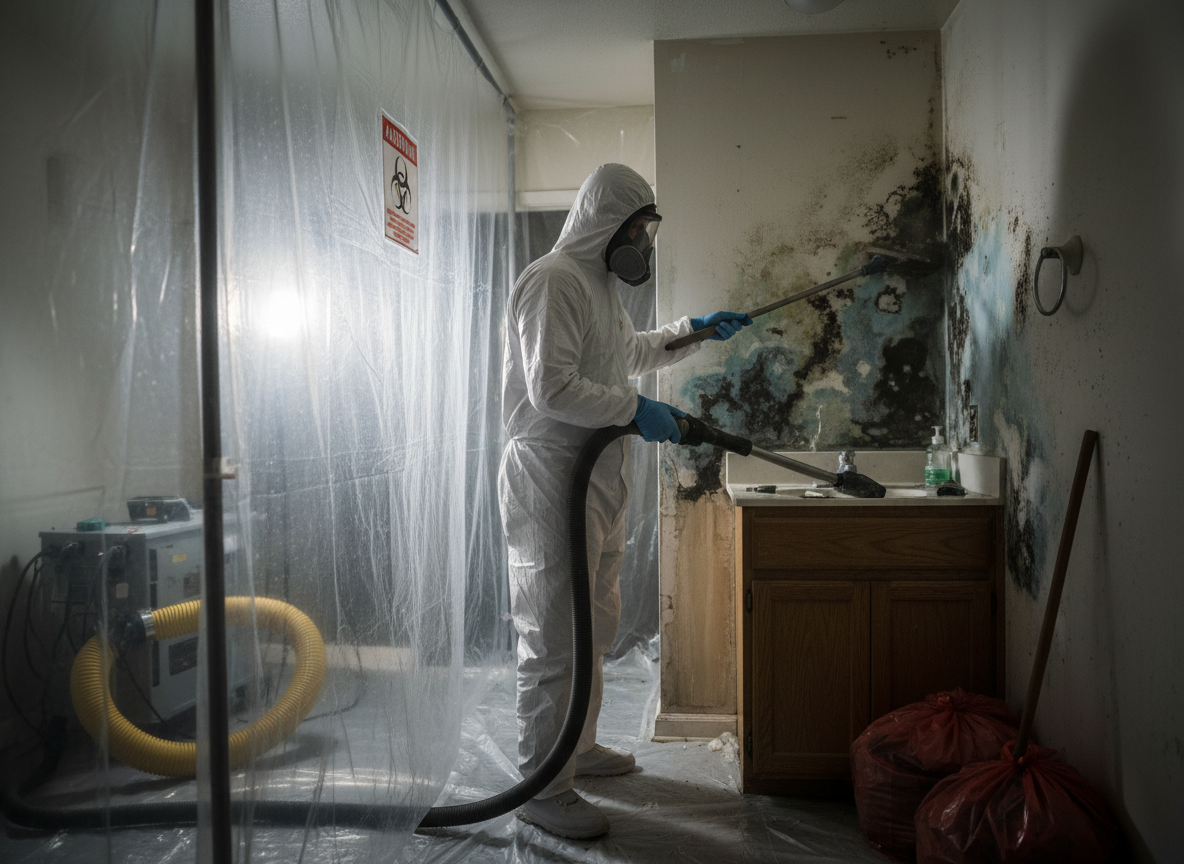
Canoga Park homes built from the 1950s onward often feature stucco exteriors and slab foundations that trap moisture from roof leaks or plumbing failures. When summer temperatures climb and residents run air conditioning continuously, condensation forms inside wall cavities and attics, allowing toxic mold to colonize drywall and insulation before visible signs appear. Technicians must cut precise access points, use negative air machines, and test for hidden growth behind cabinets and under flooring common in these ranch-style houses.
Los Angeles County building codes require proper containment and HEPA filtration during removal to prevent cross-contamination into living spaces. In neighborhoods near Pierce College and Westfield Topanga, older ductwork and flat roofs create recurring moisture pockets that standard cleaning misses. Removal crews bag and dispose of contaminated materials at approved sites while treating remaining surfaces with EPA-registered antimicrobials, then run commercial dehumidifiers until moisture readings drop below 15 percent.
Nearby areas like Woodland Hills, Chatsworth, and Winnetka share similar soil conditions and drainage challenges that push water toward foundations during rare winter rains. Technicians frequently encounter black mold on subfloors after appliance leaks in kitchens and laundry rooms. Post-remediation verification includes air sampling and visual inspection to confirm no spores remain before reconstruction begins.
Technician insight
In Canoga Park, the thing that catches most people out with toxic mold removal is how our hot dry summers push constant AC use, forcing condensation deep into the wall cavities of 1960s stucco homes near Warner Center where standard visual checks miss it entirely.
Attic Mold After Roof Leak Near Westfield Topanga
A Canoga Park homeowner noticed musty odors after heavy AC use. Inspection revealed black mold on attic insulation and rafters from a slow roof leak. Crews contained the space, removed affected materials, treated framing, and dried the area to clearance levels within three days.
How it works
- 1
Initial Assessment
Inspect all affected areas with moisture meters and borescopes to map hidden growth in Canoga Park wall cavities and attics.
- 2
Containment Setup
Install plastic barriers and negative air machines to isolate the work zone and protect adjacent rooms in the home.
- 3
Removal and Cleaning
Remove contaminated drywall, insulation, and trim, then HEPA-vacuum and treat surfaces with approved antimicrobials.
- 4
Drying and Verification
Run dehumidifiers until moisture levels stabilize, followed by air sampling to confirm clearance before any rebuild.
Pricing
Upfront quotes after inspection; final cost depends on square footage, depth of hidden growth, and access in older Canoga Park construction.